




How to Choose the Right Stroller:
A Look at Different Stroller Types for Every Family
Isabel | 15th, Sep
Shopping for baby gear can feel like a full-time job. You start looking for one simple item, and suddenly you’re comparing dozens of options that all promise to be the one thing your baby “needs.”
Strollers are a perfect example.
There are full-size models, lightweight options, double strollers, jogging strollers, and stroller frames that work with infant car seats. When you’re standing in a store or scrolling through product pages late at night, it’s easy to wonder: Which stroller type do I actually need?
The good news is that there isn’t one stroller that works perfectly for every family. The right choice depends on your child’s age, where you live, how often you’ll use it, how much space you have, and what you’re comfortable spending.
Let’s take a closer look at the most common stroller types and what each one is really designed to do.
What Are the Main Stroller Types?

Before getting caught up in colors, accessories, and clever features, it helps to understand what separates the different stroller types. Each style solves a slightly different parenting problem.
Traditional Strollers
Traditional strollers are probably what most people picture when they hear the word “stroller.”
They’re generally designed for babies around 6 months and older, although some models include infant inserts or offer enough recline to safely accommodate a newborn. They tend to have sturdy frames and a more substantial design, which can make them useful for everyday use over a longer period.
The tradeoff is weight and size.
A traditional stroller can take up more room in your trunk and may be awkward if you live in a small apartment or regularly use public transportation. If most of your walks are around the neighborhood and you have plenty of storage space, though, the added sturdiness may be exactly what you want.
Umbrella Strollers
Umbrella strollers are named for the way they fold into a slim, compact shape.
They’re among the lightest stroller types, which makes them particularly convenient for travel, quick errands, or parents who don’t want to wrestle with a heavy stroller every time they leave the house.
There is a compromise, though.
Because umbrella strollers tend to have slimmer frames and less support, they may not provide the same level of cushioning or stability as a full-size stroller. They also often come with fewer accessories and less padding.
For a quick trip to the store? Great.
For long walks over uneven sidewalks? You may want something sturdier.
Double Strollers
If you have twins or two children who are close in age, a double stroller can make everyday life considerably easier.
There are two common configurations: side-by-side and tandem, where one seat sits in front of the other.
Side-by-side double strollers can be easier to maneuver on sidewalks because both seats are positioned evenly. The downside is width. Getting through a standard doorway or fitting into a smaller elevator can become a frustrating little adventure.
Tandem models are narrower and generally easier to get through doors, but the longer frame can make steering more challenging.
When considering different stroller types, think about your everyday environment. A double stroller that works beautifully in a wide suburban neighborhood may feel very different in a crowded city.
Jogging Strollers
For parents who like to run, hike, or spend a lot of time outdoors, jogging strollers are built with a different purpose in mind.
Most jogging strollers have three wheels and are designed to handle rougher terrain. They commonly feature larger air-filled tires, suspension systems, hand brakes, parking brakes, and higher handlebars.
They can be a great fit for an active lifestyle, especially if your regular walks take you beyond smooth sidewalks.
But you probably don’t need one simply because it looks sporty. If your stroller spends most of its time going from the car to the grocery store, the extra features may not be particularly useful.
Infant Car Seat Stroller Frames
This option is a little different from the other stroller types.
Instead of having a traditional stroller seat, an infant car seat stroller frame is a lightweight frame designed to attach to an infant car seat. Some are made specifically for a particular brand, while universal frames can accommodate multiple infant car seats.
For parents with newborns who want a simple way to move an infant car seat around, this can be a convenient setup.
The important thing is to check compatibility carefully. A frame needs to be designed to work safely with the car seat you’re using.
How Do You Choose Between Stroller Types?
Once you know the basic categories, choosing becomes much less overwhelming.
Start by thinking about where the stroller will actually be used.
If you mainly need to walk across smooth sidewalks or take short trips around the neighborhood, a traditional stroller or lightweight option may be enough. If your daily routine includes rough terrain or running, a jogging stroller makes more sense.
Then think about how often you’ll use it.
A stroller that comes out every day needs to be comfortable for both you and your child. Things like steering, folding, storage, and weight can become surprisingly important when you’re dealing with them over and over again.
Newborn needs should also factor into the decision.
Some parents need a stroller that works from the newborn stage while others are happy to start using one when their baby is around 6 months old. Check the age and weight recommendations for the particular model rather than assuming every stroller is suitable from birth.
And don’t forget about longevity.
If you expect to use the stroller for several years, choose one that can accommodate your child as they grow. A stroller that works well for a small baby but becomes uncomfortable quickly may not actually save you money.
Don’t Forget About Weight, Size, and Folding

This is one of those things parents sometimes understand only after they’ve owned a stroller.
A stroller can look perfectly manageable in a showroom. Then you try to lift it into the trunk while holding your child, a diaper bag, and three things your toddler absolutely insisted on bringing along.
Suddenly, weight matters.
Before choosing among different stroller types, consider where you’ll store the stroller and how often you’ll carry it. If you travel frequently, a compact fold can be incredibly useful. If you live upstairs without an elevator, a lightweight model may become much more appealing.
Take measurements, too. Make sure the folded stroller fits your car and that the unfolded stroller can comfortably pass through the doors and spaces you use most.
What About Your Budget?
Your budget naturally narrows down your options, but it shouldn’t be the only deciding factor.
A less expensive stroller can be perfectly practical if it has the features your family actually needs. On the other hand, spending a little more may be worthwhile if you’re getting better durability, easier handling, more comfortable seating, or a design that will work for several years.
Try not to pay for features simply because they sound impressive.
Instead, ask yourself: Will I use this every week?
That simple question can eliminate a surprising number of unnecessary extras.
How Many Children Will You Be Pushing?
Family size can also make the choice much easier.
If you’re expecting twins or think you may have another baby relatively soon, it’s worth considering whether a double stroller could make sense. If you have one child and don’t anticipate needing two seats, a single stroller will usually give you more flexibility in terms of size and maneuverability.
Your future plans don’t have to determine your purchase, but they’re worth considering if you expect the stroller to become a long-term part of your family routine.
A Lightweight Option for Everyday Adventures
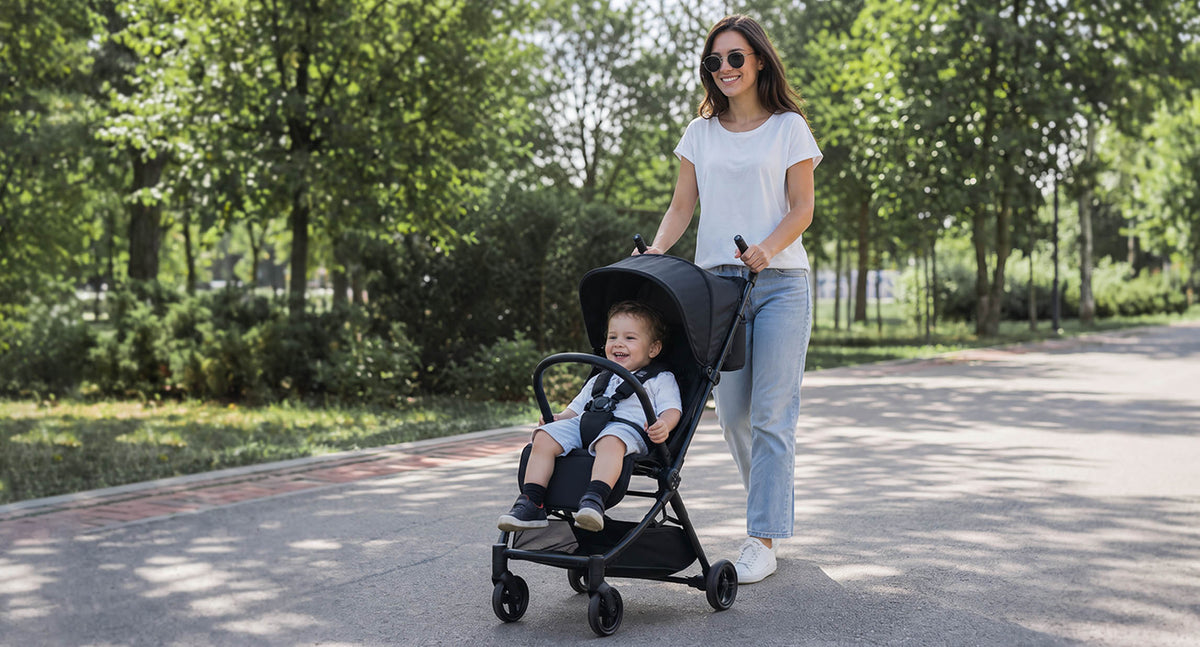
If your priority is a stroller that’s easy to carry, compact enough for travel, and practical for everyday use, the KRIDDO Cove Baby Stroller is one option to consider.
It’s priced at $149.99 and is designed for children from 6 months up to 40 pounds.
- Lightweight and easy to carry: At just 11.88 pounds, or about 5 kilograms, the stroller is designed to be easy to lift and transport. Its compact fold takes up less space than a 20-inch suitcase, making it convenient for cars, closets, and family trips.
- Comfortable for everyday outings: The spacious seat features a backrest that adjusts from 110° to 170°, plus a two-position adjustable footrest. An oversized UPF 50+ canopy provides added sun protection for walks, park visits, and outdoor adventures.
- Adapts as your child grows: Designed for children from 6 months to 40 pounds, it features a removable safety system that can switch between a five-point and three-point harness. The front bar can also be removed with one button as your child becomes more independent.
- Smooth handling: Swivel front wheels and built-in suspension help absorb bumps, while 360-degree rotation makes it easier to maneuver through crowded sidewalks, stores, and narrow spaces. Durable wheels can handle paved surfaces and grassy parks, while rear-wheel brakes provide dependable stopping.
- Keeps everyday essentials close: The spacious under-seat basket and included mom bag provide room for diapers, wipes, drinks, snacks, toys, and other essentials. For busy families, having those items within easy reach can make an ordinary outing feel a little less chaotic.
You can find the KRIDDO Cove Baby Stroller and compare its features with the needs of your own family.
The Best Stroller Type Is the One That Fits Your Life

There’s no single winner among all the stroller types.
A traditional stroller may be the better fit for everyday use. An umbrella stroller can make travel easier. Double strollers are practical for two young children, while jogging strollers are designed for active families. An infant car seat stroller frame can simplify those early newborn days.
The trick is to stop asking which stroller is “best” in general and start asking which one makes sense for your life.
Think about your child’s age, your daily routine, your home and car, how often you’ll use the stroller, and how many children you need to accommodate. Once you do that, the overwhelming list of choices usually gets a whole lot smaller.